What Are Graphics Libraries?
- Provide various functionalities that are required in drawing images on the screen
- Provide low-level access to the GPU, optimizing performance
- Manage visual effects like lighting, textures, and shaders
- Support real-time rendering for interactive applications
- 개발자가 일일이 화면의 픽셀을 건드릴 필요 없이, 라이브러리가 제공하는 함수나 API를 사용해 간편하게 그래픽 작업 처리 가능
3D Graphics Libraries
- Low-level APIs
- Proivdes the most fundamental functionalities
- Users have huge freedom in programming / 상대적 난이도가 높다
- ex) OpenGL, Metal, Vulkan, DirectX
- Windowing Libraries
- Encapsulate common functionality with a low-level APIs
- Provides APIs for basic user-interaction (ex. mouse, keyboard, sounds)
- ex) GLFW, Qt, Pyglet, Pyrender, Pygame
- High-level Development Tools
- Support users so that they don't have to worry too much about graphics and performance while developing applications
- Often customized to support specific applications
- ex) Unreal, Unity, Blender, Maya, CAD softwares
- 3D 그래픽에 필요한 물리엔진, 3D 모델 불러오기, 다양한 편집 기능 등을 지원함
- 직접 그래픽 API를 다룰 필요 없이, 비교적 편리하게 게임이나 그래픽 콘텐츠 제작 가능
OpenGL
- Developen in 1992 by Silicon Graphics(SGI)
- Has been used as a global standard for 3D graphics
- These days, Vulkan is seen as its modern successor
- Ideal library for learning the basics of computer graphics
Programming Language
- OpenGL : cross-platform and can be used with various languages
- WebGL : web-based version of OpenGL
Why WebGL?
- Easy access and interactive coding through web-based services
Rasterization
Converts 3D objetcs into a 2D image by filling pixels based on polygon coverage
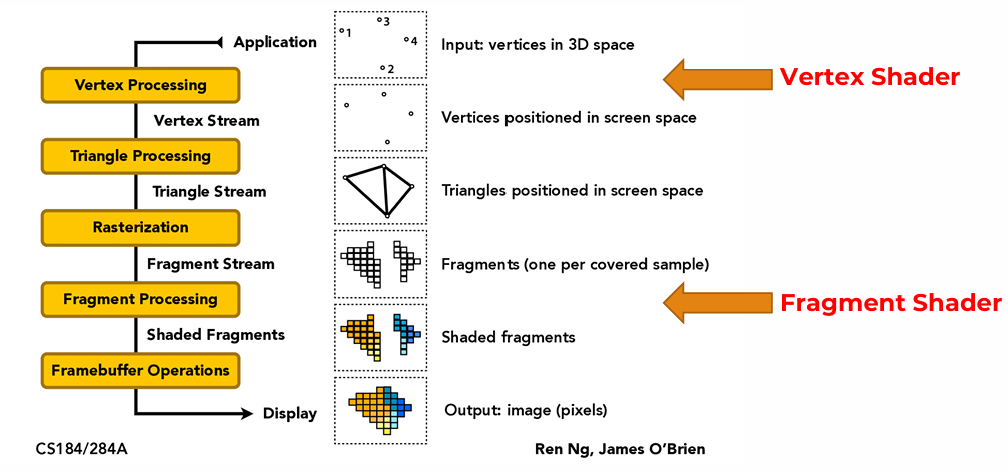
Vertex Shader
* Shader : GPU가 실행하는 작은 프로그램
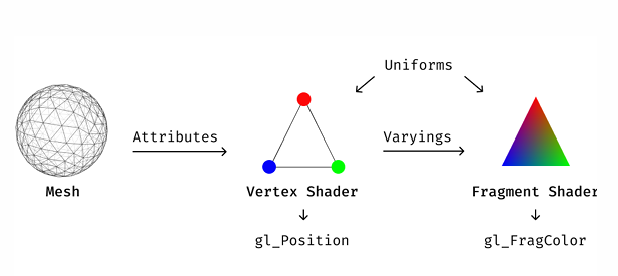
Vertes shader per object
- Inputs
- Attributes : The per-vertex data stored in the vertex array such as position
- Uniforms : The per-object data that remain constant for multiple executions of a shader
- Outputs
- Must include the built-in variable(내장변수), gl_Position, which stores the clip-space vertex position
- Usually include normal and texture coordinates
Fragment Shader
Fragment shader per pixel, and responsible for determining the final color of each pixel
- Attributes(colors, texture coordinates, normals) are smoothly interpolated between vertices to determine the value for each fragment
- Inputs
- Data from the Vertex Shader (ex. interpolated normals, texture coordinates)
- Outputs
- The final color (ex. FragColor) that will be rendered on the screen
OpenGL Shader Language(GLSL)
- C-like language
- Works on GPU
- Supports Vector and Matrix